Every contractor can show proof of insurance. Almost none can show proof of program.
Compligence turns the safety work you already do — training, site inspections, corrective action — into one organized, time-stamped record that stands up when it matters: an OSHA inspection, a GC's prequalification, an insurance review, or a courtroom.
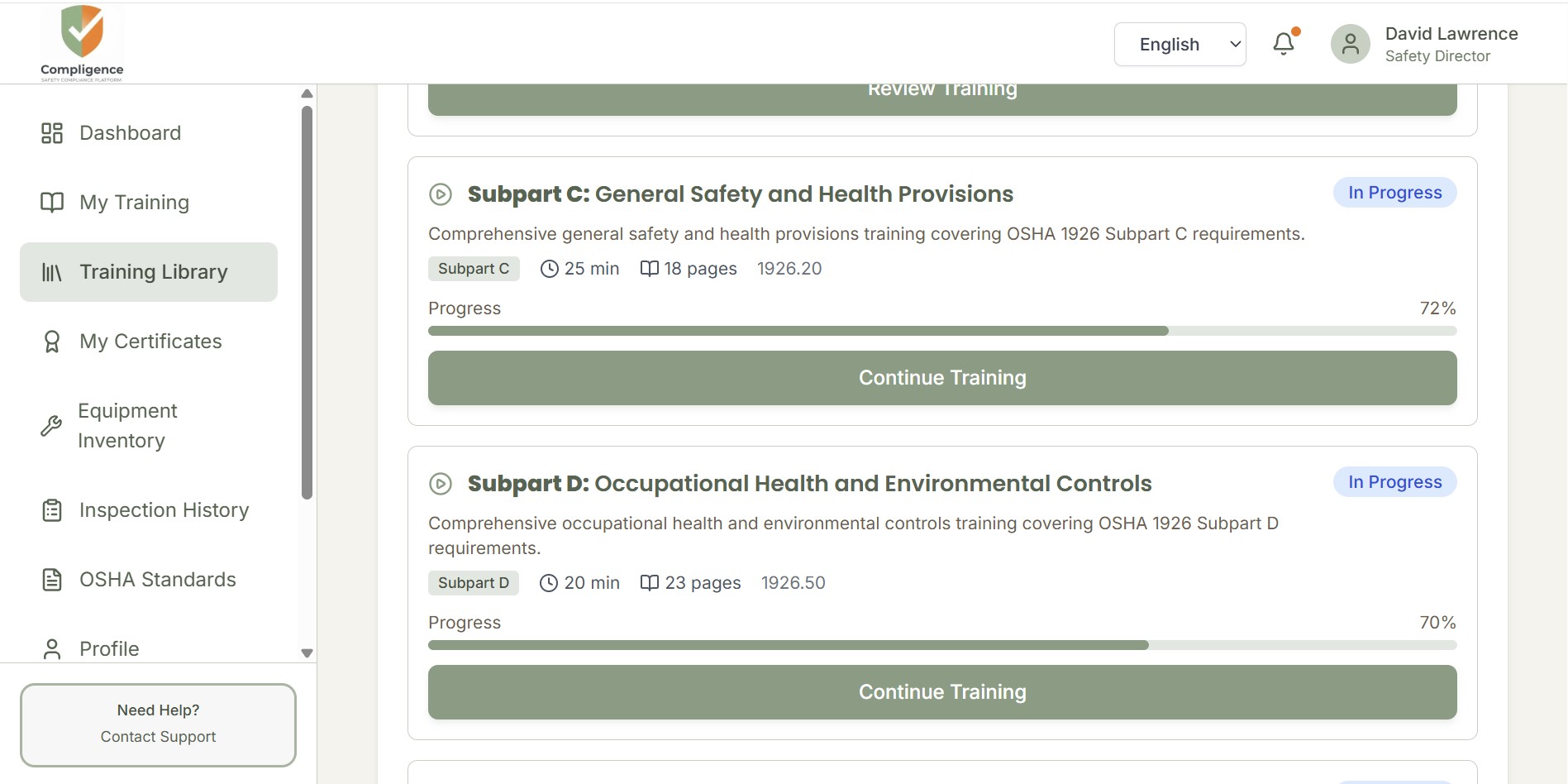
The documentation framework has been in OSHA's own Field Operations Manual all along. We're the only ones who built the system that produces it.
Built by the person who used to write the citations.
You already run a real safety program.
You don't need anyone to tell you what a citation costs or what a lawsuit does — if you've run safety for any length of time, you've lived it. The toolbox talks happen. The walks get done. Your people get trained.
Then OSHA arrives, or a GC's prequal packet lands, or a lawyer sends a records request — and almost none of it can be proven. Sign-in sheets in a truck. Certificates in email. Inspections in someone's memory.
The entire industry built tools for preventing the incident. Nobody built the system for proving your program on the day one happens anyway.
The gap was never your effort. It's your record.
The fix was in OSHA's own playbook all along.
OSHA's own framework describes how employers who genuinely train their people, inspect their sites, and enforce their rules should be treated. Most companies do that work. Almost none can prove it — because no one ever built the system that produces the proof.
That's what Compligence is. Not another training library. Not another checklist app. The system that turns a real safety program into a record that demonstrates it — built by someone who spent ten years on the other side of the clipboard, examining exactly these records.
One platform. One record. Four things it does for you.
Proof your people were trained.
Real courses on the standards that actually get cited — with engagement tracking, signed acknowledgments, and time-stamped certificates. Not click-through theater.
Proof you were looking.
Mobile site inspections on a documented, regular cadence — photos, findings, and fixes, all in the file.
Proof you acted.
When something's found, the record shows what happened next: correction, verification, retraining. Every time, for everyone.
One file when anyone asks.
OSHA, a general contractor, your insurer, your lawyer — the answer is the same organized record, produced in minutes.
The same record wins you work.
Defense is only half of what documentation does. The other half is offense:
Prequalification, answered.
When the GC's packet asks for your training records, inspection program, and enforcement history — you export the file instead of assembling a story.
The sub nobody worries about.
GCs and owners award work to contractors whose programs they can see. A provable record is a bid asset.
Better conversations with your insurer.
Documented training, documented inspections, documented correction — the trajectory underwriters want to see.
You're already paying for safety. Compligence is how that spend counts twice: the record that stands ready for OSHA is the same record that wins prequalification, bids, and insurance conversations.
Your crew gets more than a certificate.
Training in the language your people actually speak — full English, Spanish, and Korean, not machine-translated slides. A quick reference they can pull up on a phone in the field when they need the answer now. Credentials that belong to them.
Safety programs work when workers are genuinely part of them. Protection for the company and real value for the crew aren't competing goals — here they're the same system.
More about the worker experienceIf you need to make the case internally.
The current federal maximums, for the slide you show leadership:
Maximum per serious violation
Maximum per willful or repeat violation
Per violation, not per inspection — a single inspection can produce many.
And in many states, a citation can follow you into civil litigation as evidence of negligence — where the exposure stops having a ceiling.
Built from the other side of the clipboard.
Compligence was designed by a former OSHA Compliance Safety and Health Officer with ten years of federal field experience — hundreds of inspections, on the inspector's side of every one.
He built this platform around a simple fact: investigations follow patterns. What gets examined, what gets cited, what documentation changes the outcome — none of it is random. Compligence is that knowledge, turned into your record.
Curious what the documentation defense actually is? Start with a conversation →
"The last time I presented this documentation to an OSHA inspector, they reviewed it, acknowledged the defense, dropped the citation — and told my employer: 'You need to pay this guy more.'"
David Lawrence
Chief Safety Officer, former OSHA CSHO
Simple on the surface. Thorough underneath.
Train
Assign courses by trade and task. Crews complete them on any device, in their language.
Inspect
Walk your sites on a schedule the record proves. Photograph, flag, assign fixes.
Document
Everything lands in one defensible file automatically: who, what, when, in what language, with what follow-up.
Stand ready
When the knock comes, you're not assembling a story. You're handing over a record.
There's a deliberate method under this — built from how OSHA investigations actually work. We show it in the demo.
Request a DemoBeyond OSHA
Comprehensive coverage across all major safety standards.
Founding Partners — fifteen founding seats, then the era closes.
We're onboarding fifteen founding partners across construction's trades — white-glove, one company at a time, at terms that never return. Seats are filling.
Request a DemoOne honest limitation.
Compligence can't protect a company that isn't actually running a safety program. The proof only exists if the work happened.
If you're doing the work — we make it provable.
Be ready before you need to be.
The best time to build your record was the day you broke ground. The second-best time is before the next inspection.